Understand
Recognize the patterns influencing how you think, feel and move through everyday life.
 Skip to content
 Take your time. Your next step is waiting whenever you’re ready.
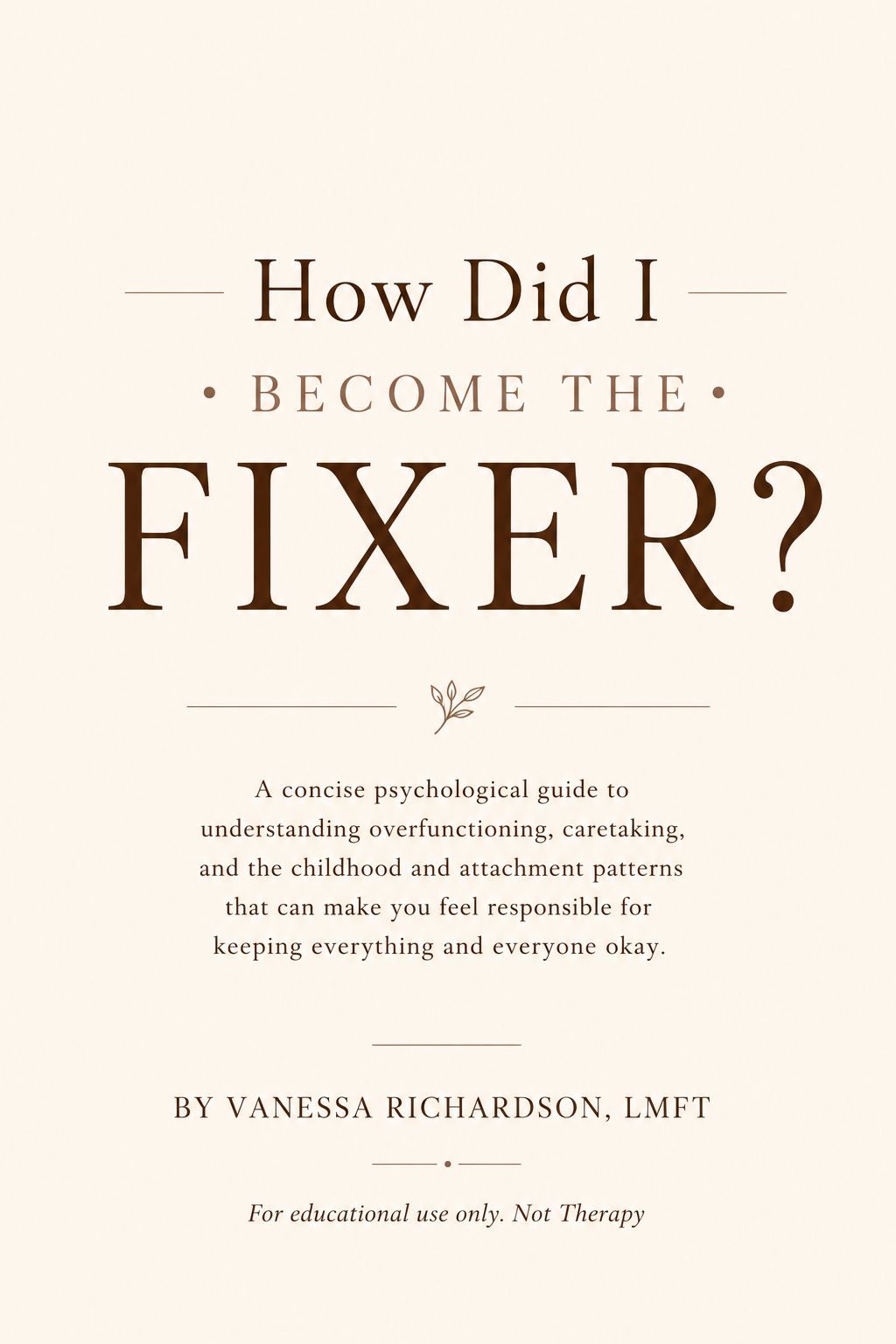
A concise psychological guide to understanding overfunctioning, caretaking, and the childhood and attachment patterns that can make you feel responsible for keeping everything and everyone okay.
Have you ever wondered why you automatically step in when something goes wrong?
Why you feel responsible for solving other people’s problems, managing their emotions, keeping the peace, or making sure everything gets done—even when no one actually asked you to?
How Did I Become the Fixer? is a compassionate psychological guide for understanding the patterns behind overfunctioning, caretaking, and feeling responsible for everyone around you.
Being dependable can be a strength. But when being “the capable one” becomes a role you feel unable to put down, it can leave you exhausted, resentful, overwhelmed, or disconnected from your own needs.
Sometimes, the instinct to fix everything did not begin in adulthood.
You may have learned early that being helpful kept things calm. That anticipating other people’s needs made relationships feel safer. That being responsible earned approval. Or that there simply wasn’t room for you to be the person who needed help.
Over time, these adaptations can become deeply familiar ways of relating to others.
This guide invites you to explore where those patterns may have come from—and what they may be costing you now.
This is not about becoming less caring.
It is about understanding when caring has quietly turned into responsibility for things that were never entirely yours to carry.
You can be supportive without solving everything.
You can love people without managing their lives.
And you can allow others to show up for you, too.
How Did I Become the Fixer? offers a thoughtful starting point for understanding the experiences that may have taught you to become the person everyone relies on—and for considering who you might be when you no longer have to hold everything together.
By Vanessa Richardson, LMFT
For educational use only. Not Therapy.
Recognize the patterns influencing how you think, feel and move through everyday life.
Create space to explore your experience with curiosity instead of judgment.
Consider new interpretations and create more intentional responses to challenges.
Turn awareness into small, sustainable shifts that support your everyday wellbeing.
Healing often begins when we stop trying to force change and start becoming curious about what our mind and body are trying to tell us.” A gentle reminder
 Optimized by Seraphinite Accelerator