Understand
Recognize the patterns influencing how you think, feel and move through everyday life.
 Skip to content
 Take your time. Your next step is waiting whenever you’re ready.
Are you the person everyone turns to when life gets difficult—but rarely the person who reaches out when you are struggling?
Maybe you are dependable, composed, and capable. You know how to listen, reassure, problem-solve, and keep moving forward. But when it comes to your own emotions, asking for comfort or allowing someone else to take care of you can feel surprisingly difficult.
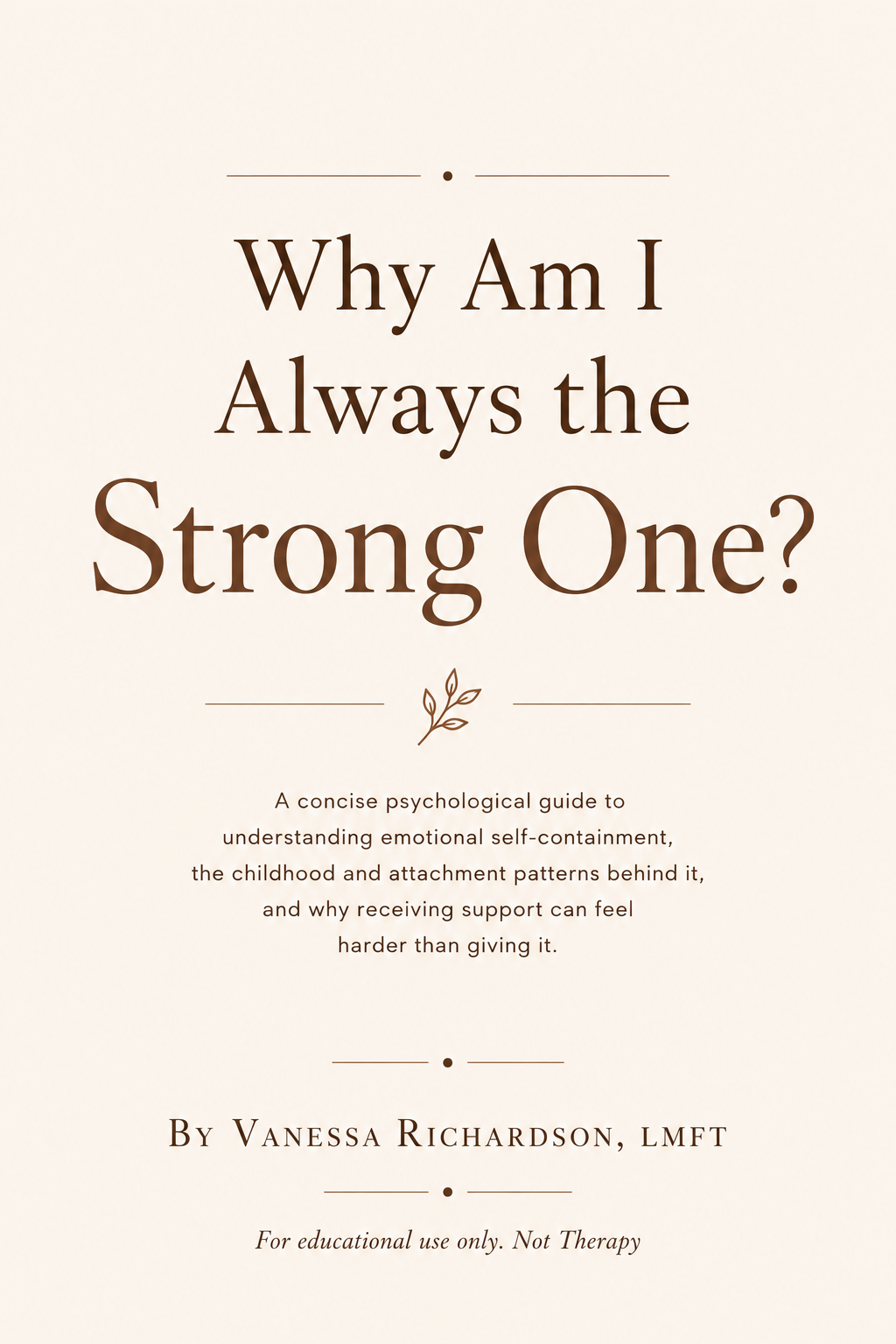
Why Am I Always the Strong One? is a compassionate psychological guide to understanding emotional self-containment, the childhood and attachment patterns that can shape it, and why receiving support may feel much harder than giving it.
Being strong is not the problem.
But sometimes strength becomes more than a quality—it becomes a role you feel responsible for maintaining.
You may have learned early that your emotions were too much, that other people already had enough to deal with, or that being independent was safer than depending on someone who might not be available when you needed them.
Perhaps you became mature early. You learned to handle things yourself. You stopped expecting others to notice when something was wrong. Or you became so practiced at appearing okay that even the people closest to you may not realize when you need support.
Over time, emotional self-containment can feel less like something you do and more like simply who you are.
This guide invites you to explore what may exist underneath that strength with curiosity, compassion, and greater self-awareness.
This is not about becoming less strong.
It is about expanding what strength is allowed to look like.
Strength can include saying, “I’m having a hard time.”
It can include accepting help without immediately trying to repay it.
It can include allowing someone else to sit beside you instead of always being the person holding everyone else up.
And it can include discovering that needing support does not erase your independence, competence, or resilience.
Why Am I Always the Strong One? offers a thoughtful starting point for understanding why you may have learned to carry so much alone—and for exploring what becomes possible when strength no longer means having to handle everything by yourself.
By Vanessa Richardson, LMFT
For educational use only. Not Therapy.
Recognize the patterns influencing how you think, feel and move through everyday life.
Create space to explore your experience with curiosity instead of judgment.
Consider new interpretations and create more intentional responses to challenges.
Turn awareness into small, sustainable shifts that support your everyday wellbeing.
Healing often begins when we stop trying to force change and start becoming curious about what our mind and body are trying to tell us.” A gentle reminder
 Optimized by Seraphinite Accelerator