Understand
Recognize the patterns influencing how you think, feel and move through everyday life.
Take your time. Your next step is waiting whenever you’re ready.
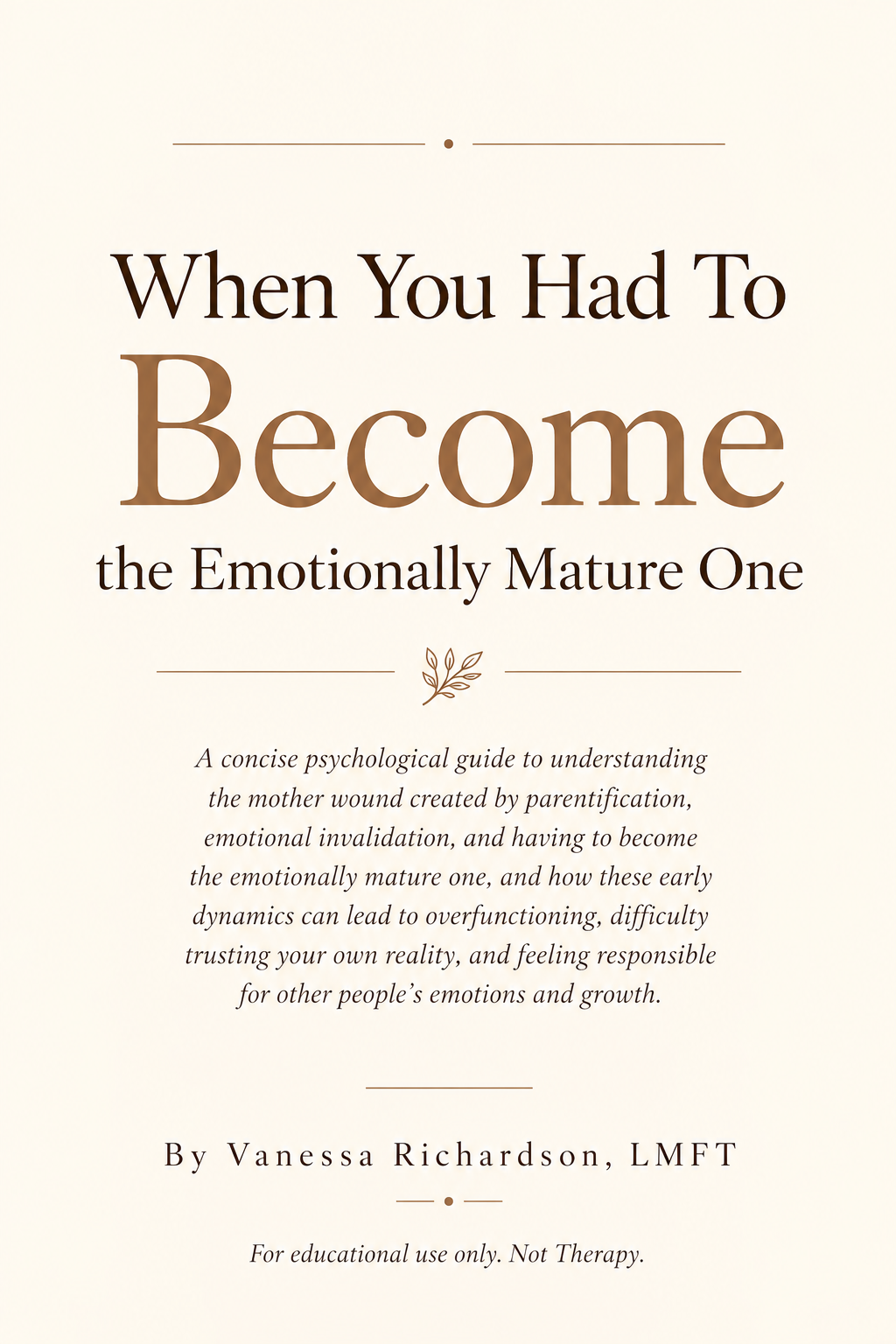
What happens when the person who was supposed to help you understand your emotions needed you to manage theirs instead?
Maybe you learned early to be mature, responsible, understanding, or emotionally careful.
You became good at reading the room.
You noticed changes in mood before anyone said anything. You learned when to stay quiet, when to help, when to comfort, and when your own feelings might create more tension.
Perhaps you were called mature for your age.
But what looked like maturity from the outside may sometimes have been adaptation.
Mother Wound: When You Had to Become is a compassionate psychological guide to understanding the mother wound that can develop through parentification, emotional invalidation, role reversal, and having to become the emotionally mature one before you were developmentally ready.
A mother wound does not require a mother to have been intentionally cruel or entirely absent.
Sometimes, the wound develops through what a child repeatedly needed but could not consistently receive.
Emotional safety.
Validation.
Protection.
Comfort.
Permission to have needs without worrying about how those needs would affect someone else.
When a parent struggles with their own emotional regulation, unresolved experiences, or capacity to provide consistent emotional support, a child may begin adapting around the parent’s needs.
Instead of being comforted, you may have become the comforter.
Instead of having your emotions understood, you may have learned to explain or suppress them.
Instead of being allowed to simply be a child, you may have become responsible, independent, accommodating, or unusually emotionally aware.
Eventually, those adaptations can follow you into adulthood.
You may become the person who holds everything together while quietly wondering why no one seems to do the same for you.
This guide invites you to explore those patterns with compassion rather than blame—and to understand how experiences that once helped you maintain connection may still be shaping the way you relate to yourself and others today.
Understanding the mother wound is not about reducing an entire relationship to blame.
It is about making room for your experience.
Two things can exist at the same time.
You can understand that your mother had her own history, limitations, struggles, and unmet needs—and still acknowledge what you needed from her.
You can have compassion for what she experienced without minimizing what you experienced.
You can love someone and recognize that aspects of the relationship hurt you.
And you can understand where a pattern came from without continuing to carry it.
You were never supposed to be responsible for another adult’s emotional development.
You were allowed to need comfort.
You were allowed to have feelings that someone else did not understand.
You were allowed to be uncertain, imperfect, dependent, and still developing.
You were allowed to be the child.
Mother Wound: When You Had to Become offers a thoughtful starting point for understanding what may happen when emotional maturity becomes something a child develops out of necessity—and for exploring who you can become when you no longer feel responsible for holding everyone else together.
By Vanessa Richardson, LMFT
For educational use only. Not Therapy.
Recognize the patterns influencing how you think, feel and move through everyday life.
Create space to explore your experience with curiosity instead of judgment.
Consider new interpretations and create more intentional responses to challenges.
Turn awareness into small, sustainable shifts that support your everyday wellbeing.
Healing often begins when we stop trying to force change and start becoming curious about what our mind and body are trying to tell us.” A gentle reminder