Understand
Recognize the patterns influencing how you think, feel and move through everyday life.
 Skip to content
 Take your time. Your next step is waiting whenever you’re ready.
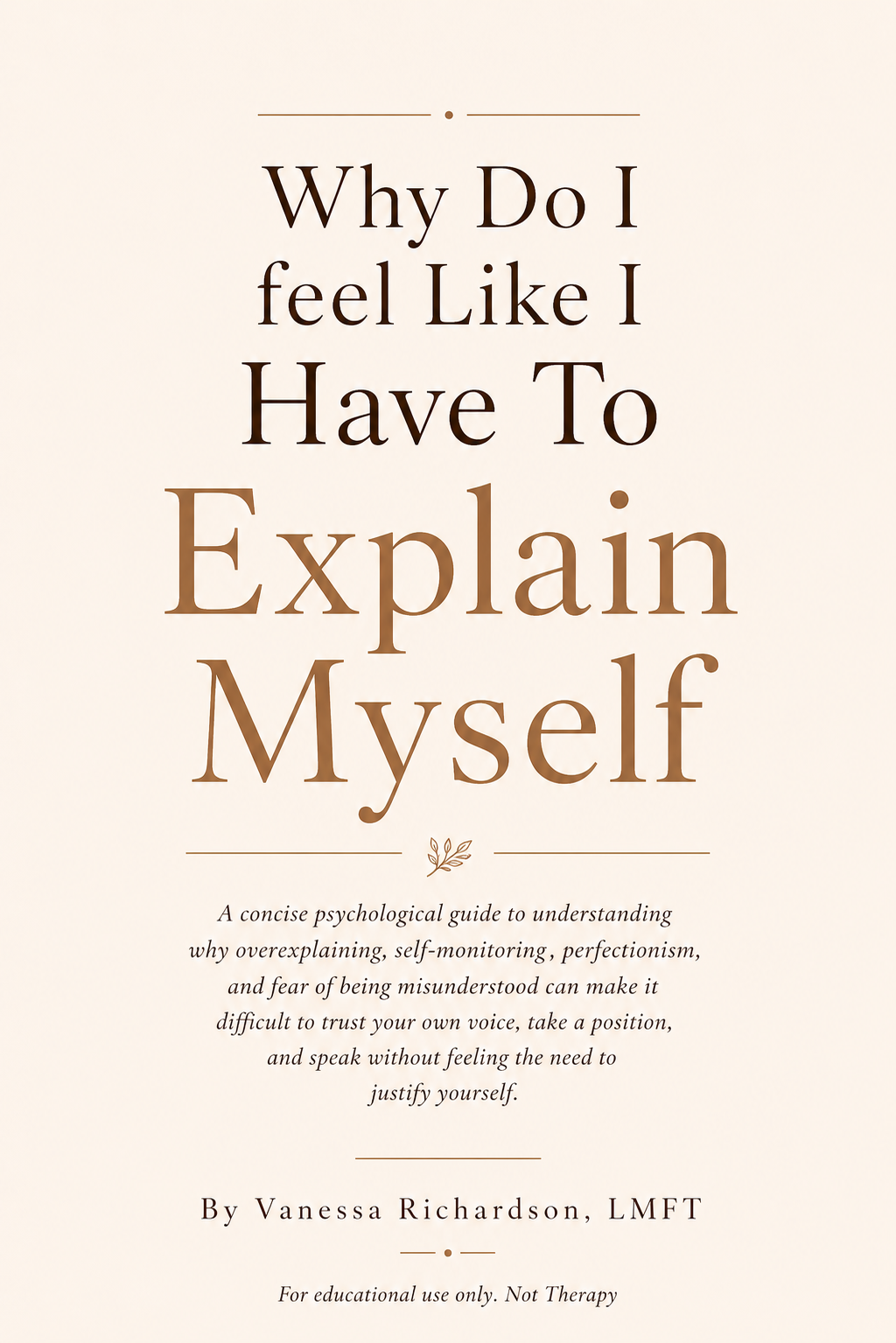
A concise psychological guide to understanding why overexplaining, self-monitoring, perfectionism, and fear of being misunderstood can make it difficult to trust your own voice, take a position, and speak without feeling the need to justify yourself.
Do you find yourself explaining your decisions long after a simple answer would have been enough?
Maybe you carefully rehearse what you are going to say, add extra details so no one gets the wrong idea, or feel uncomfortable leaving a statement without explaining exactly why you think, feel, or chose what you did.
You may even walk away from conversations wondering:
Did I explain that clearly enough?
What if they misunderstood me?
What if they think I meant something I didn’t?
Why Do I Feel Like I Have to Explain Myself? is a compassionate psychological guide to understanding overexplaining, self-monitoring, perfectionism, and the fear of being misunderstood—and why these patterns can make it difficult to trust your own voice, take a position, and speak without feeling responsible for how everyone interprets you.
Overexplaining is not always about having too much to say.
Sometimes, it is an attempt to feel safe.
If your intentions were frequently questioned, your emotions dismissed, your decisions criticized, or your words interpreted in ways you did not intend, you may have learned that simply expressing yourself was not enough.
You had to make your case.
You had to provide context.
You had to make sure the other person understood.
You may have learned to monitor your tone, anticipate objections, soften your opinions, prepare explanations, and carefully manage how your words might be received.
Over time, this can create a painful habit: instead of trusting what you know, feel, or want, you begin searching for enough evidence to make your position acceptable to everyone else.
This guide invites you to understand where that need may come from—and what it might feel like to trust your own voice without constantly defending it.
This is not about becoming less thoughtful in the way you communicate.
It is about recognizing that you do not have to make yourself perfectly understandable to everyone in order for your experience to be valid.
You can say no without presenting a case.
You can make a decision without convincing everyone that it was the correct one.
You can express an opinion without anticipating every possible objection.
You can clarify yourself when necessary without taking responsibility for every interpretation another person might have.
And you can allow someone to disagree with you without immediately questioning whether you were wrong to speak at all.
Your voice does not become more valid because you have explained it perfectly.
Why Do I Feel Like I Have to Explain Myself? offers a thoughtful starting point for understanding why speaking simply and confidently may feel more vulnerable than it appears—and for exploring what becomes possible when you begin trusting that your thoughts, feelings, boundaries, and decisions do not always require a defense.
By Vanessa Richardson, LMFT
For educational use only. Not Therapy.
Recognize the patterns influencing how you think, feel and move through everyday life.
Create space to explore your experience with curiosity instead of judgment.
Consider new interpretations and create more intentional responses to challenges.
Turn awareness into small, sustainable shifts that support your everyday wellbeing.
Healing often begins when we stop trying to force change and start becoming curious about what our mind and body are trying to tell us.” A gentle reminder
 Optimized by Seraphinite Accelerator