Understand
Recognize the patterns influencing how you think, feel and move through everyday life.
 Skip to content
 Take your time. Your next step is waiting whenever you’re ready.
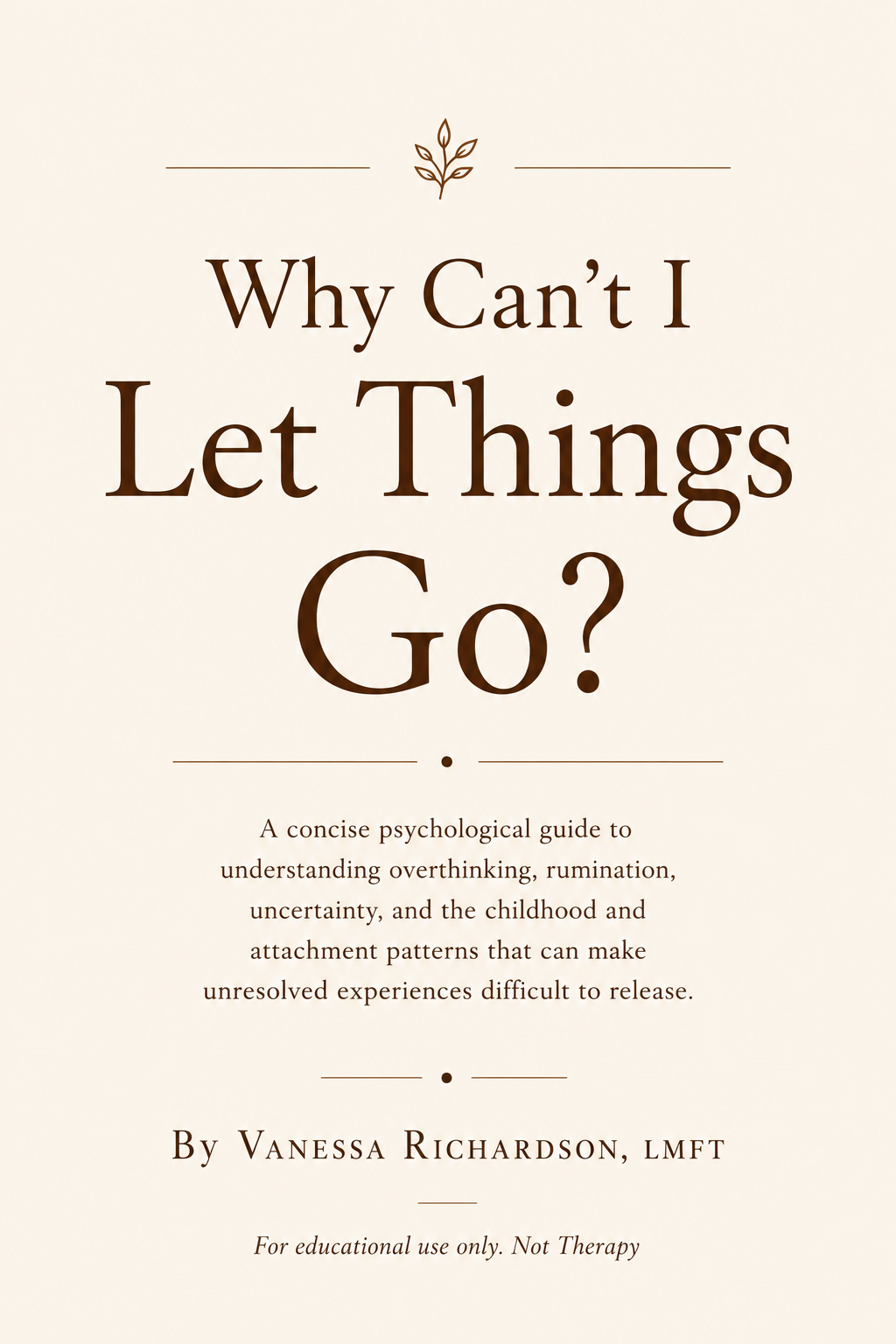
A concise psychological guide to understanding overthinking, rumination, uncertainty, and the childhood and attachment patterns that can make unresolved experiences difficult to release.
Do you replay conversations long after they are over?
Do you find yourself analyzing what someone said, wondering what you should have done differently, searching for answers, or trying to make sense of an experience that never gave you the closure you wanted?
Maybe other people tell you to “just let it go,” but your mind does not seem to work that way.
Why Can’t I Let Things Go? is a compassionate psychological guide to understanding overthinking, rumination, uncertainty, and the childhood and attachment patterns that can make unresolved experiences especially difficult to release.
Sometimes, holding on is not about refusing to move forward.
It is about trying to understand what happened.
When experiences feel confusing, painful, inconsistent, or unfinished, the mind may continue returning to them in search of clarity. You may replay details, imagine different outcomes, analyze another person’s behavior, or wonder whether there was something you missed.
For some people, this pattern can have deeper roots.
If uncertainty once felt unsafe, if conflict was unpredictable, if you had to carefully monitor other people’s moods, or if important experiences were never fully acknowledged or resolved, your mind may have learned that understanding everything was a way of protecting yourself.
Over time, thinking can begin to feel like preparation, control, or even safety.
This guide invites you to explore why your mind may have such difficulty leaving certain experiences unfinished—and what may exist underneath the need to keep searching for answers.
This is not about forcing yourself to stop thinking.
It is about understanding why your mind keeps returning to certain places.
You can acknowledge what happened without endlessly analyzing it.
You can accept that something mattered without allowing it to occupy your thoughts indefinitely.
You can move forward without having every answer.
And sometimes, letting go does not mean deciding that something was okay—it means recognizing that you no longer need to keep solving it.
Why Can’t I Let Things Go? offers a thoughtful starting point for understanding why unresolved experiences may remain so mentally and emotionally present—and for exploring how to create space between what happened in your past and the life you are living now.
By Vanessa Richardson, LMFT
For educational use only. Not Therapy.
Recognize the patterns influencing how you think, feel and move through everyday life.
Create space to explore your experience with curiosity instead of judgment.
Consider new interpretations and create more intentional responses to challenges.
Turn awareness into small, sustainable shifts that support your everyday wellbeing.
Healing often begins when we stop trying to force change and start becoming curious about what our mind and body are trying to tell us.” A gentle reminder
 Optimized by Seraphinite Accelerator