Understand
Recognize the patterns influencing how you think, feel and move through everyday life.
 Skip to content
 Take your time. Your next step is waiting whenever you’re ready.
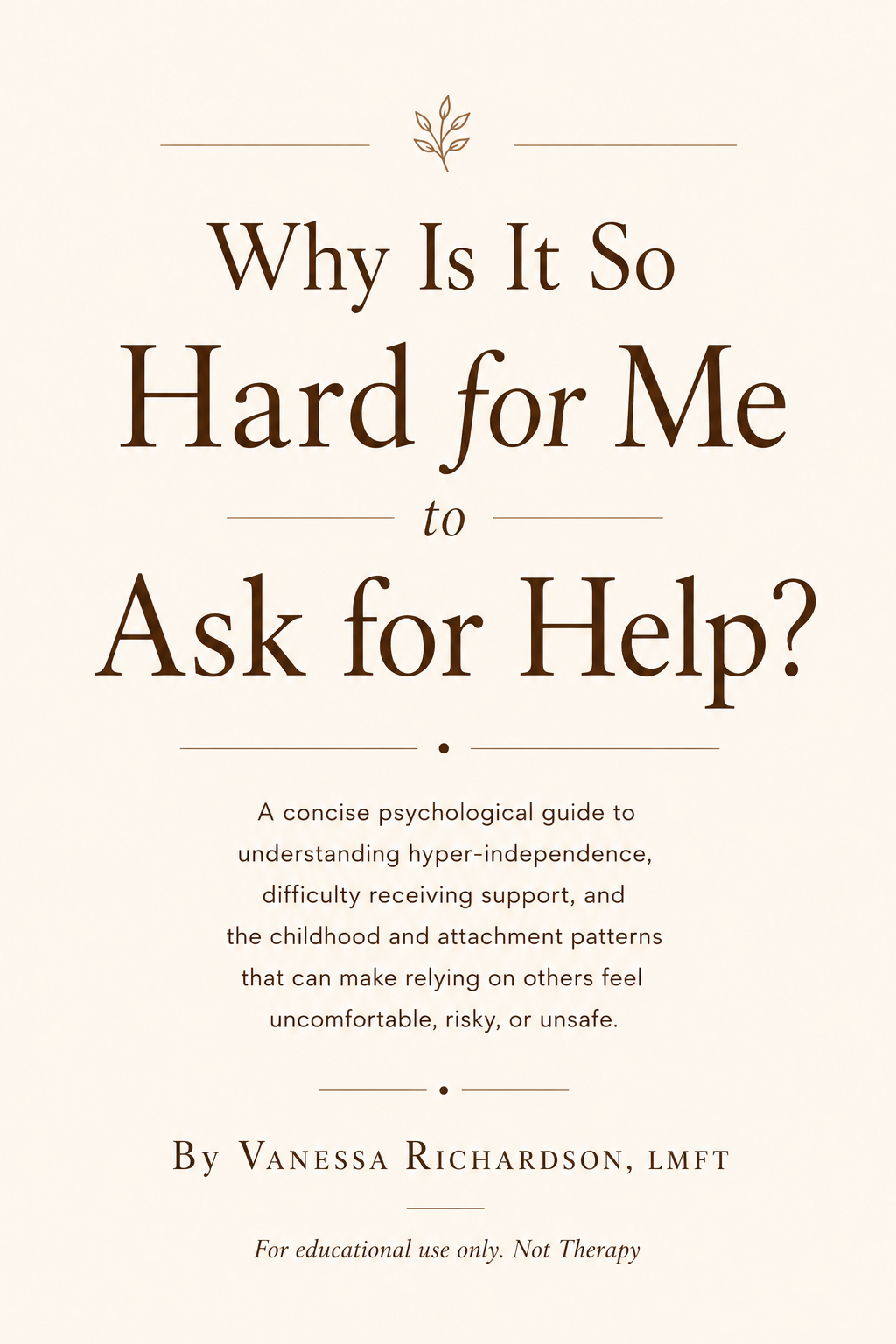
A concise psychological guide to understanding hyper-independence, difficulty receiving support, and the childhood and attachment patterns that can make relying on others feel uncomfortable, risky, or unsafe.
Do you find it easier to struggle quietly than to tell someone you need support?
Maybe you are comfortable being the person others depend on, but the moment you need something yourself, you hesitate. You tell yourself you can handle it. You minimize what you are going through. You wait until things become overwhelming—or simply take care of everything alone.
Why Is It So Hard for Me to Ask for Help? is a compassionate psychological guide to understanding hyper-independence, difficulty receiving support, and the childhood and attachment patterns that can make relying on other people feel uncomfortable, risky, or unsafe.
Independence can be a valuable strength.
But sometimes, extreme self-reliance develops because depending on others did not always feel dependable.
You may have learned early that your needs would not consistently be noticed, understood, or met. Perhaps asking for help resulted in disappointment, criticism, rejection, guilt, or feeling like a burden. Maybe the adults around you were overwhelmed themselves, so you learned to need less, expect less, and handle more on your own.
Eventually, “I can do it myself” can become more than a preference.
It can become protection.
Even when trustworthy people enter your life, accepting their support may still feel unfamiliar. You might worry about owing someone, losing control, appearing weak, being disappointed, or becoming dependent on something that could disappear.
This guide invites you to understand those reactions with curiosity rather than judgment.
This is not about giving up your independence.
It is about recognizing that independence and connection do not have to compete with each other.
You can be capable and still need support.
You can solve problems and still allow someone to help you.
You can trust yourself without believing you must do everything yourself.
And asking for help does not make you less strong—it allows other people the opportunity to show you that you do not always have to carry things alone.
Why Is It So Hard for Me to Ask for Help? offers a thoughtful starting point for understanding why self-reliance may have once felt necessary—and for exploring what it might feel like to remain independent while slowly making room for safe, dependable support.
By Vanessa Richardson, LMFT
For educational use only. Not Therapy.
Recognize the patterns influencing how you think, feel and move through everyday life.
Create space to explore your experience with curiosity instead of judgment.
Consider new interpretations and create more intentional responses to challenges.
Turn awareness into small, sustainable shifts that support your everyday wellbeing.
Healing often begins when we stop trying to force change and start becoming curious about what our mind and body are trying to tell us.” A gentle reminder
 Optimized by Seraphinite Accelerator